
Homemade Butter Pie Crust
Using just a handful of ingredients and a food processor to speed up prep, this Homemade Pie Crust is surprisingly easy to make.
Servings: 2 9-inch pie crusts
Ingredients
- 1 cup unsalted butter (2 sticks of butter)
- 2½ cups all-purpose flour spooned and leveled (313 grams)
- 1 teaspoon kosher salt
- 6-10 tablespoons ice water divided
Instructions
- Place the bowl for food processor, plastic dough blade, flour, and pie dish in the refrigerator to chill thoroughly.
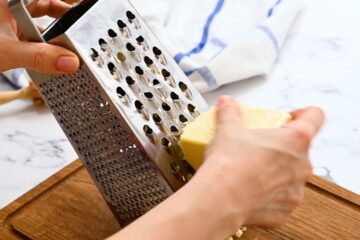
- Using a box grater, grate 1 cup unsalted butter. Alternatively, cube the butter into ½-inch cubes. Place grated/cubed butter into the freezer for 15-20 minutes.
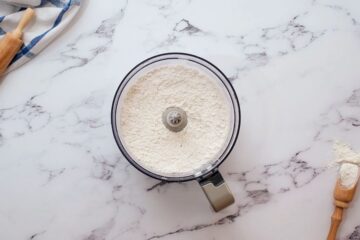
- Remove the food processor bowl, dough blade, and flour from the refrigerator and assemble the food processor with the dough blade. Place 2½ cups all-purpose flour and 1 teaspoon kosher salt in the food processor and pulse a couple times to combine.
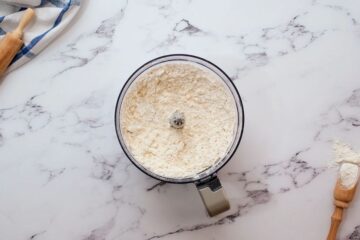
- Add the frozen grated butter to the food processor and pulse, 2-3 times until it resembles coarse crumbs, or the butter is distributed through the flour evenly.
- Through the opening, drizzle in 2 tablespoons of ice water and pulse once. If needed, add additional ice water 1 tablespoon at a time until the dough comes together easily and begins to form large clumps. The dough will feel moist and a little sticky, but not feel overly wet. For me, I typically need 6-10 tablespoons ice water to reach the perfect consistency.

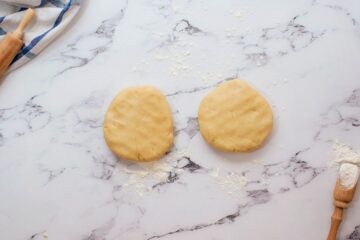
- Using floured hands, turn the dough out onto a floured workspace. Press the dough together until evenly combined and form it into a disk. Cut in half and then flatten each disk to about 1- inch thickness. Wrap each disc tightly in plastic wrap and refrigerate for at least 2 hours and up to 5 days before using.
- Remove the dough from the refrigerator a couple of minutes ahead before rolling out the crust so that it is easier to work with. Lightly flour your work surface and rolling pin. Roll out the disk of dough from the center moving outward in all directions until dough is even and the diameter of the circle is about 12 inches--a couple of inches larger than your pie pan.
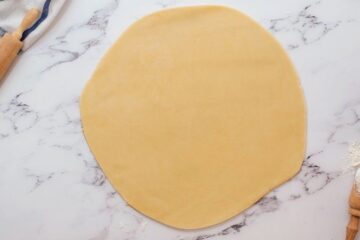
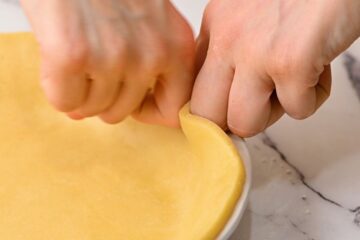
- Let the dough rest for a couple of minutes and then very carefully transfer the pie crust to the pie pan. Gently press the dough onto the sides of the pie plate and then fold under the overhanging crust so that the edge is thick and even.
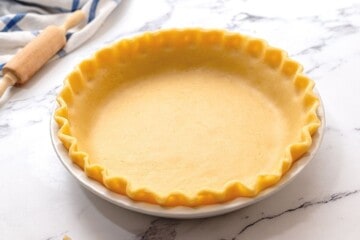
- To flute the edges of the pie crust, use your knuckle from one finger to indent the pie crust and then two fingers from your other hand to pinch the crust, and form the fluted edge.
- Place the pie crust into the refrigerator for 1 hour before using it for your pie recipe. Be sure to bake the crust on a baking stone or metal baking sheet to help the heat distribute evenly and not crack your pie plate.
To Pre-Bake/Blind Bake Pie Crust
- Position an oven rack in the lower-middle portion of your oven and preheat to 375℉/190℃.
- Remove the pie plate from the refrigerator and press parchment paper into the pie shell, folding over the edges so that the entire crust is covered, as best as possible. Fill to the top of the foil with pie weights or dried beans. Place the pie plate on a baking stone or metal baking rack to help prevent the pie plate from baking.
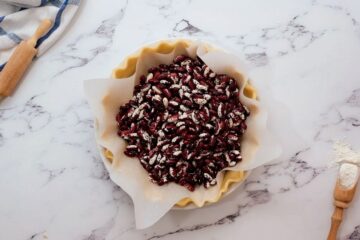
- Place the pie crust into the oven and bake for 15 minutes.
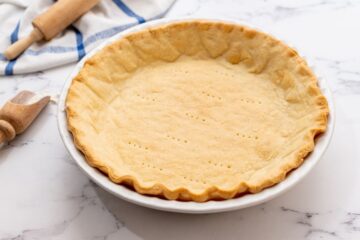
- After 15 minutes, remove the pie crust from the oven and carefully remove the parchment paper and pie weights by lifting up the corners of the parchment paper. Use a fork to dock the bottom of the pie crust several times.
- Return to the oven, and bake for 8 more minutes for a partially baked crust OR for 15-18 more minutes for a fully baked crust. If you notice your edges are browning too quickly, use a pie crust shield or cover with foil.
- Chill the crust completely if using for a no-bake pie.
Video
Notes
Storage: Homemade Pie Crust Dough can be made up to 5 days in advance and stored in the refrigerator. Alternatively, you can also opt to freeze the pie crust dough for up to 3 months.
Freezing Instructions: To freeze the pie crust dough, wrap in several layers of plastic wrap and then place into a large freezer-safe storage bag. The pie dough will keep in the freezer for up to 3 months. To use the frozen dough, thaw completely in the refrigerator. This will take anywhere from 24-36 hours. And be sure after forming the pie crust using the thawed dough, that you chill again before baking.
For the ice-cold water. Fill a glass with ½ cup of water and then add ice. Scoop out the water directly from the glass of ice water.
Chill the pie dough for at least 2 hours before rolling out. This step is non-negotiable; it’s the most crucial in the entire pie crust recipe.
Fluted Edges: If you are in a hurry or it overwhelms you to flute the edges of the pie crust, simply make sure your crust is even and thick around the edges and proceed with the recipe.
To Make Without a Food Processor: In a large mixing bowl, whisk together the flour and salt. Add the cold butter and toss to coat the butter with flour. Use a fork or pastry cutter to cut butter into the flour mixture until all the flour is coated and crumbly. Pour 2 tablespoons of the ice water into the mixture and stir gently with a rubber spatula. Add additional water, 1 tablespoon at a time, stirring after each, until the dough comes together. Do not add too much water and do not overmix the dough. Turn dough out onto a floured workspace and form into a ball. Divide dough in half and flatten it into two 1-inch thick disks. Tightly wrap both disks in plastic wrap and refrigerate as directed.
This recipe makes the equivalent of two 9-inch pie crusts.
Nutrition values are estimates and are based on ⅛ of one 9-inch pie crust.
Nutrition
Calories: 173kcal | Carbohydrates: 15g | Protein: 2g | Fat: 12g | Saturated Fat: 7g | Trans Fat: 1g | Cholesterol: 31mg | Sodium: 148mg | Potassium: 24mg | Fiber: 1g | Sugar: 1g | Vitamin A: 355IU | Calcium: 7mg | Iron: 1mg
