
Easy Roast Turkey
This simple process for roasting a turkey will produce a delicious, juicy, tender, roasted turkey that will wow your dinner guests!
Servings: 12
Ingredients
- 1 whole turkey fully thawed if needed
- 1 recipe turkey brine optional
- ¼ cup canola oil
- kosher salt and pepper
- 1 large quartered yellow onion optional
- 1 large quartered apple, any variety optional
- 2 stalks celery optional
Instructions
- Remove the turkey from the packaging. Remove the giblets (which could be in either the body or neck cavity) and remove and discard the plastic pop-up timer as well.
- Place the turkey on a roasting pan fitted with a rack, breast-side up. Pat the turkey dry with paper towels.
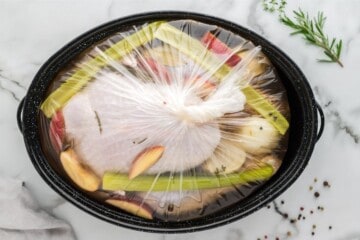
- If desired, add the quartered onion, apple, and celery stick to the cavity of the turkey. Brush the skin liberally with canola oil. If you did NOT brine your turkey, liberally sprinkle your turkey with salt and pepper. Tuck the wings under the turkey.
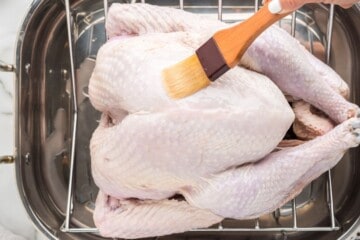
- Let the turkey rest at room temperature for 30-60 minutes, while you preheat the oven. Position a rack on the lowest section of the oven and preheat to 500°F (260℃). If your oven does not reach 500°F, set it to a minimum of 450°F (232℃).
- Roast the turkey at 500°F (260℃) for 30 minutes. After 30 minutes, reduce the oven to 350°F (175℃) and insert an oven-safe digital probe thermometer into the thickest part of the breast.
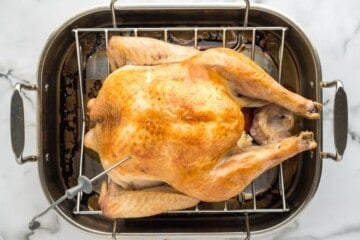
- Cook the turkey until the breast reaches 160-162℉ (71-73℃)*. If the turkey breasts are browning too quickly, carefully tent them with foil, leaving the legs and thighs exposed. Plan for approximately 10-13 minutes of cooking time per pound of turkey.
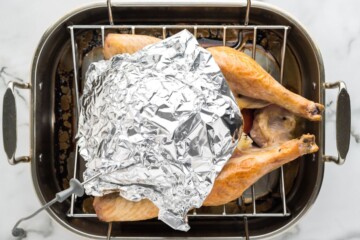
- Once the turkey breast reaches the target temperature, remove it from the oven and check the temperature in the thickest part of the thigh to ensure it has cooked evenly. The thigh should be close to 170℉ (77℃). If not, return to the oven for 10 minutes, then recheck the temperature. Keep in mind that the temperature will continue to rise as the turkey rests. You want the final temperature to be 165°F (74℃) in the breast and 175-180°F (80-82℃) in the thigh.
- Remove the turkey from the oven and tent it with foil. Let the turkey rest for at least 30 minutes (or up to 60 minutes if needed).
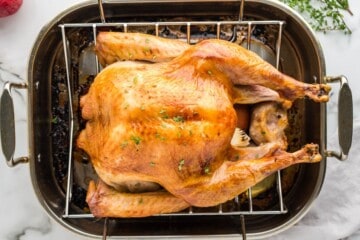
- After resting the turkey, carve and serve it. To carve the turkey, remove the wings and then the thighs first by popping out the joints that attach the wings and thighs to the bird, then cut straight through the joint. Separate the thighs and drumsticks if desired. To carve the turkey breasts, slice the meat off the rib cage, cutting as close to the rib bones as possible. Cut the breast meat into individual slices if desired.
Notes
*Temperature of Turkey: As the turkey rests, it will continue to rise in temperature. I typically pull it out once the breast reaches 160°F and the thigh reaches 170°F, as I find my roasted turkey rises at least 5 degrees as it rests. You want the final temperature to be 165°F (74℃) at the breast and 175-180°F (80-82℃) at the thigh.
Brining the Turkey First: After removing the turkey from the packaging, place it in a prepared chilled brine. Place the turkey in a large brining bag or container and pour the brine over the turkey. Cover with additional water until the turkey is fully submerged. Cover/seal the bag and refrigerate the turkey in the brine for 8 to 18 hours. Remove from the brine, rinse, place the turkey breast-side up on the roasting pan, and pat dry with paper towels.
Seasoning: If you do not brine your turkey, keep it simple and season with kosher salt and pepper, or use Cajun seasoning, Seasoned Salt, or your favorite poultry seasoning.
Storage: Refrigerate the leftover turkey meat within 2 hours of removing it from the oven to prevent food poisoning. Store the leftover meat in the refrigerator for up to 4 days or freeze it for up to 3 months.
Canola Oil: Do not be tempted to swap the canola oil out for butter, as the butter will burn at this high heat.
Nutrition
Calories: 549kcal | Protein: 103g | Fat: 13g | Saturated Fat: 2g | Polyunsaturated Fat: 3g | Monounsaturated Fat: 5g | Trans Fat: 0.05g | Cholesterol: 304mg | Sodium: 535mg | Potassium: 1066mg | Sugar: 0.3g | Vitamin A: 136IU | Calcium: 50mg | Iron: 4mg
