Instant Pot High Altitude Conversion

Aug 30, 2019
This post may contain affiliate links. Please see our disclosure policy.
Wondering how to adjust your Instant Pot recipes for high altitude? This printable conversion chart will help you adjust your recipes so that all your Instant Pot Recipe turn out perfectly!
Use this conversion chart to make any of these Instant Pot Recipes and learn basics of Instant Pot Cooking at Instant Pot 101.
Cooking at High Altitude
If you live 3,000 feet above sea level, most recipes will need to be adjusted to account for the altitude change.
At higher elevations, the air pressure is lower which causes several things to occur.
Effects of High Altitude
- The boiling point of water is lowered, meaning foods will be cooking at a lower temperature, which increases the cooking time. The higher the elevation the lower the boiling point becomes, increasing the cook time for every thousand feet rise above sea level.
- Liquids evaporate faster, so amounts of flour and liquids may need to be changed in recipes.
- Gases expand more rapidly, so rise time on baked goods may need to be decreased, as well as leavening agents.
Using the Instant Pot at High Altitude
When using the Instant Pot at higher altitudes, you do not need to worry about accounting for liquid evaporating as the pressure cooker seals in all the moisture. However, you do need to account for the lower boiling point.
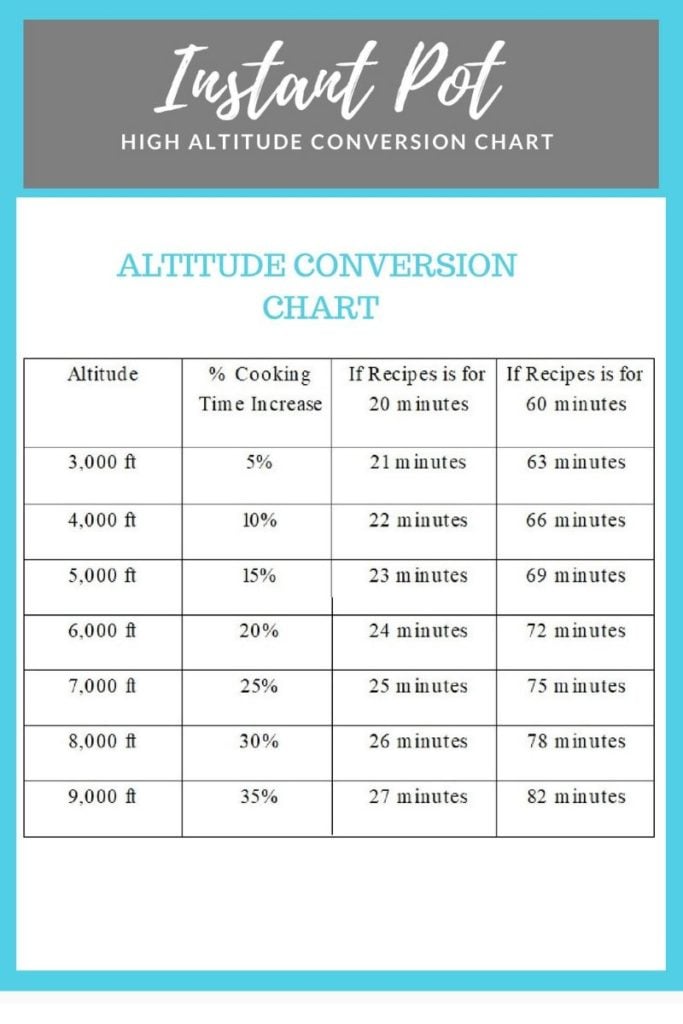
The formula for success when using your electric pressure cooker is to increase pressurized cook time by 5% for every 1000 feet above 2000 feet elevation.
Print this chart to help you convert your favorite recipes.
 Important Tips for Using Instant Pot at Higher Altitudes
- If making Instant Pot Yogurt, you do not need to make adjustments to the recipe.
- If you are sauteing or thickening a recipe AFTER pressure cook time has elapsed, like in Instant Pot Beef Stew, be sure to watch the liquid level carefully, you may need to add in ¼ to ½ cup more liquid, as it will take longer for your recipe to thicken at higher altitude.
- For more tips on cooking and baking at High Altitude, check out these great tips from Betty Crocker.




Beans are not getting soft…42 minutes with 15 minutes of NPR. Still not soft?!!
Hi April! Can you tell me how many dried beans you used, the type, and how much water you used? Also, keep in mind adding salt can interfere with the softening of the beans.
I moved from sea level to iver 5,000 and my first 3 recipes went burn cycle. I had to lower the temperature for several cycles, then it adjusted. I love it and good to know the adjustments necessary. Thanks.
Kristen, do you know how to find the pressure in pounds for a 3 qt or 6 qt? I have both but use my 3 qt most. I'm at 5234'. When I cook with pressure, it never vents steam - it's always very quiet unless I touch the weight. I've read articles on pressure cooking, but none mention Instant Pots. I don't own a pressure cooker like my 91 yo mom had when I was growing up 🙂
Hi Nel! Instant Pot model's pounds per pressure range from 13-15psi. That said, when you account for being at your elevation it will be closer to 10-12psi. As for steam, your pressure cooker should be venting steam unless your vent knob is open--not sure if that is what you are asking! Let me know if you need further clarification.