
This post may contain affiliate links. Please see our disclosure policy.
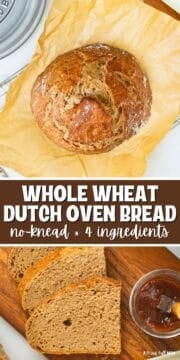
Dutch Oven Bread is hands-down the easiest way to make homemade whole wheat bread. No kneading, no fancy equipment! Just a few minutes of prep and a handful of ingredients and you can easily create a beautiful loaf of artisan whole wheat bread right at home!
This No Knead Whole Wheat Bread is crusty on the outside, tender on the inside, and full of hearty flavor. It is the perfect starter bread recipe as it is simple, forgiving, and rewarding.

Kristen's Keys for No-Knead Whole Wheat Bread

While an exceptionally easy recipe, I have a few key pointers to keep in mind before starting.
- You must use a Dutch Oven. This no-knead bread must be baked in a 3½ to 6-quart heavy-duty dutch oven that can withstand temperatures up to 450℉ (230℃). No other pan will conduct heat in the same way.
- Measure flour with care. A kitchen scale is the most accurate way to measure flour when making bread (or ANY baked good). If you don't have a scale, use a spoon to scoop the flour into the measuring cup, rather than scooping directly from the canister.
- Use active dry yeast NOT rapid rise or Instant yeast. We want a slow and steady rise.
- The flour is interchangeable. Whole wheat flour gives this bread a hearty flavor, but you can use white wheat flour or all-purpose flour for a lighter texture.
- Parchment paper is optional but helpful. It makes lifting the bread in and out of the Dutch oven seamless. Just be sure to use parchment paper safe up to 450℉ (230℃).
- Plan to make the dough at least 8 hours prior to baking the bread. You need time to let the yeast work it's magic.
Happy Cooking! xo Kristen
5-star Reader Review
This is the absolute best no knead bread recipe I have ever tried. It's hearty and moist and any add-in you throw at it turns out wonderful! -LouAnne⭐⭐⭐⭐⭐
How to Make No-Knead Dutch Oven Bread
Making bread at home can feel intimidating. But with this easy no knead whole wheat bread recipe and my step-by-step guidance, there is no need to be intimidated. 😉
Step One: Measure Flour
The most accurate way to measure the flour is to place a mixing bowl on a kitchen scale, zero it out, and set it to measure in grams. Scoop flour into the bowl until the scale reads 500 grams.
👉🏻No Scale? Lightly spoon flour into a measuring cup and level. You will need 3¾ cups of whole wheat flour.

Step Two: Combine Dough
Add the yeast and salt to the mixing bowl and whisk to combine. Add the warm water, and using a wooden spoon or spatula, stir until just combined. It is meant to be a shaggy (slightly damp) dough.
👉🏻Your water should be between 100-115℉ (38-46℃ ). Any colder water won't activate the yeast, while hotter water can kill the yeast. Use a digital thermometer for accurate results.

Step Three: Let Rest
Cover the mixing bowl with a clean kitchen towel or piece of plastic wrap and let sit at room temperature for at least 8 hours or up to 18 hours. I find 12 hours to be perfect! This slow rise develops incredible flavor and gives the dough that beautiful airy structure.

Step Four: Preheat the Oven and Dutch Oven
When you are ready to bake the bread, place the Dutch Oven in the oven and turn the oven to 450°F (230℃). Preheating the Dutch oven helps create that signature crusty exterior.
👉🏻 Using an Enameled Dutch Oven? A few brands state not to preheat empty (most say preheating in the oven is fine, just not on the stove--check your manual carefully). Simply skip the preheat and add an additional 5-10 minutes to the baking time.
Step Five: Shape Dough
While the oven is preheating, use the time to shape the dough. Remember it is meant to be a rustic dough, so don't worry about it being perfect. The less you work the dough, the better.
- Place a piece of parchment paper onto the counter and very lightly dust with flour.
- Turn the dough onto the parchment paper and shape into a circle with lightly floured hands.
- Brush off excess flour from dough and parchment paper and let rest until oven is fully preheated.

Step Six: Bake
Carefully transfer the shaped dough into the preheated Dutch oven, cover, and bake for 30 minutes. Then uncover and bake for an additional 20 minutes, or until the crust is deep golden brown.
👉🏻 Unsure if your bread is fully cooked? Stick a digital thermometer into the center of the loaf. The internal temperature should be between 207-209°F (97-98℃).

Step Seven: Cool
The hardest part about making this bread is waiting for it to cool! But in order to prevent it from being gummy and next to impossible to slices, you need to let it fully cool. Immediately remove the bread from the Dutch Oven and let cool on a cooling rack for at least 30 minutes before trying to slice.

Recipe Notes & Modifications
- Vary the Flour: While this recipe is written using whole wheat flour, you can swap it out for white whole wheat flour, whole wheat pastry flour, bread flour, all-purpose flour, or a combination of flours. Whatever flour is used, it must measure 500 grams. And because different varieties of flour have different weights, a scale is critical here. Gluten-free flour blends and self-rising flour are not recommended!
- Optional Additions: Add up to 1 cup of chopped nuts (walnuts, almonds, or pistachios), seeds (pumpkin seeds, sesame seeds or sunflower seeds), and/or dried fruit (raisins or dried cranberries) to the flour mixture before adding water to the dough. (Or try my cranberry walnut bread recipe.)
- Dutch Oven Size & Recommendations: A smaller Dutch oven yields a higher, rounder loaf, while a larger Dutch oven causes the dough to spread more. While still delicious, the bread will be flatter. I prefer a 4-quart Dutch oven for a beautiful tall loaf. And while the Staub brand is my favorite, Lodge Dutch ovens work well and are much more affordable.
- Storage Tips: Once fully cooled, wrap well in plastic wrap or place in an airtight container. Store at room temperature and use within 3 days. Alternatively, wrap well in foil, place in a freezer-safe bag, and freeze for up to 1 month. Defrost at room temperature. For best results, slice as needed rather than slicing all at once--this will prevent the bread from drying out.

Serving Suggestions
This artisan-style whole wheat bread is heartier and chewier than my honey whole wheat bread and reminds me a bit of the texture of sourdough bread. It is perfect toasted, slathered with butter, or served alongside one of the following cozy soups:
No-Knead Whole Wheat Bread

Video
Ingredients
- 500 grams whole wheat flour, ~3¾ cups
- 2 teaspoons kosher salt
- 1 teaspoon dry active yeast
- 2 cups warm water, between 100-115℉
Instructions
- Place a large mixing bowl on a kitchen scale, change units to grams, and zero it out. Add whole wheat flour until the scale reads 500 g (for 500 grams.) To measure flour without a scale, fluff the flour in its container, then spoon into a measuring cup, leveling off the excess. Measure out 3¾ cups whole wheat flour and place in mixing bowl (see recipe notes if using a different variety of flour).

- Add 2 teaspoons kosher salt and 1 teaspoon dry active yeast to the flour and mix well to incorporate. Add 2 cups warm water to the flour mixture and use a wooden spoon or spatula to mix until the flour is fully moistened. Resist the urge to overmix. Stop mixing once there are no longer any dry pockets of flour.

- Cover the mixing bowl with plastic wrap or a clean kitchen towel, and let rest at room temperature for at least 8 hours or up to 18 hours.

- After the dough has risen, turn out the dough onto a lightly floured piece of parchment paper or lightly floured surface. Lightly flour your hands and then roughly shape the dough into a circle. The dough will be sticky! Brush excess flour off the dough ball and parchment paper and let the dough rest while the oven preheats.

- Place the Dutch oven pan, fitted with a lid, into the oven and then set to preheat the oven to 450℉ (230℃), with the pan in the oven.
- Once the oven is preheated, carefully remove the pan from the oven and carefully drop the shaped bread into the heated pan.

- Place the lid on the Dutch oven and bake for 30 minutes covered. Carefully remove the lid and bake for an additional 20 minutes, or until the bread is golden and the internal temperature of the bread reaches 207-209°F (97-98℃).

- Remove bread from dutch oven and let cool on wire rack for 30-45 minutes before slicing and serving.

Equipment
- kitchen scale the most accurate way to measure flour!
Notes
Nutrition
Nutrition information is automatically calculated, so should only be used as an approximation.
This post was originally published in 2017 but has been updated in 2025 .




Can I proof the dough in my INstant Pot for 4 hrs and then into the dutch oven?
Hi Rochelle! I have not tried that, but in theory it would work. If you give it a go, let us know how it works out
I made the bread yesterday. If you have an Instant Pot Duo 6 or 8 with a yogurt button you can raise any bread dough in it. Pam the metal insert pot and put the dough directly into it. Press the yogurt button, set it on low and the time on 4 hrs.
It turned out great. My husband loved it too. But the crust is so hard I have a difficult time cutting it w/o tearing the bread. I use a serrated knife. What do you suggest? BTW our favorite Instant Pot roast is your Horseradish Roast recipe.
I am so glad you enjoyed this bread! The crust can be a bit tougher, I am able to cut--once cooled with serrated knife, but it is a chewier crust. Most bakeries recommend tearing for thicker crusts actually. 🙂
Try using a very sharp regular chef's knife! I stopped using a serrated "bread" knife on bread years ago because it just seemed to tear the crumb and crust, rather than slice neatly.
Hi Kristen, I just want to verify that this dough does not require a second proofing. Thank you!
Hi Jen! That is correct. The overnight proofing is more than sufficient. Enjoy!
Great! Thank you!
I have a stainless steel Dutch oven. Will this work?
Hi Shirley! It absolutely will work 🙂 I hope you enjoy your bread!
My bread was glued to the bottom of the Dutch oven. You don’t grease it or anything, right? The bread tasted great!!
Hi Beth! I am glad you enjoyed the bread, but sorry it stuck to the bottom of your dutch oven. Did you shape your dough on a floured cutting board? That extra flour should have helped prevent your bread from sticking.
I've made this using another formulation of flour and water and it was absolutely delicious. Very, very sticky. I'm looking forward to trying this with whole wheat flour. My husband, who's from England said this is (type) is the best crusty bread he's had since he's been an American citizen...and that's been 18 years. 🙂 I'm so delighted that your version offers whole wheat and I'll certainly be mixing a batch tonight.
This is a very sticky dough, but with a pastry knife, a little extra flour sprinkled around the boule' and softly floured hands - it rolls just perfect.
Hi Kim! I hope you enjoy this whole wheat version! And yes, very sticky--but great tips! Thank you!
Flour your hands before handling.
GREAT tip!! Thanks!
Kristen-- I'm perplexed about something. 2 cups water, 3 3/4 cups whole wheat flour. Two cups of water weighs 473g (grams). According to the King Arthur Flour chart at https://www.kingarthurflour.com/learn/ingredient-weight-chart.html 3 3/4 cups of flour at 113g/cup weighs 424g. So the weight ratio of water to flour is 473/424, or 112% hydration the way that pro bakers talk. That's an *extremely* wet dough. 100% hydration is so wet that the dough is very hard to handle. Your pics, and the glowing recipe reviews, don't indicate such a wet dough. So, I'm puzzled.
Happy New Year!
Hi Steve!
I understand how this may confuse you. This is a very wet dough, but it bakes up perfectly every time for me. If I feel it is too wet, I simply sprinkle with a bit of flour before shaping into a ball. I hope you give it a try.