How to Use an Instant Pot

Updated Dec 23, 2025
This post may contain affiliate links. Please see our disclosure policy.
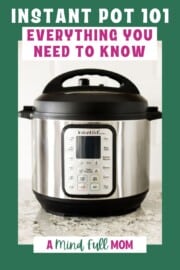
Feeling overwhelmed by your new Instant Pot? This beginner's guide will simplify the essentials so you feel confident and ready to cook delicious recipes using your Instant Pot.

Instant Pot 101

If you have recently been gifted an Instant Pot or purchased one yourself, you may be feeling excited. Or maybe you are overwhelmed. Maybe you read the instruction manual that came with the instant pot and are feeling even more confused. It is really lacking in information!
Through the years, I have helped millions of people learn how to use the Instant Pot, and I want to help you too!
In this guide, I'll cover:
- Instant Pot parts and functions
- A step-by-step water test (your first run!)
- Natural pressure release vs. quick release
- Safety tips and keys to success
- Troubleshooting common issues
- My favorite accessories
Stick with me, you are well on your way to mastering Instant Pot Cooking.
Happy Instant Pot Cooking! xo Kristen
Instant Pot Parts (and How to Clean Them)
Before we talk about how the Instant Pot works, let's break down the standard pieces and parts of the Instant Pot so you know which piece is which and how to clean each part.


The Buttons (or Functions)
Spoiler alert: The majority of the buttons on the Instant Pot are useless and should not be used. (more on that in my Instant Pot Settings Guide). The following settings are your go-tos and likely the only buttons you will ever push on an Instant Pot.
- Pressure Cook/Manual: Your go-to button for controlling cook time.
- Sauté: Brown or simmer food directly in the inner pot.
- Keep Warm: Automatically turns on after pressure cooking.
- Slow Cook: Works, but times/temps aren't always accurate. See my guide on using your Instant Pot as a slow cooker.
- Yogurt: Used to make and incubate Instant Pot yogurt.
- Adjust/Temp-Pressure: Switch between high/low pressure or adjust temps for sauté/slow cook/yogurt.
Step-By-Step Instructions for Instant Pot Cooking
To get started, it is best to cook water in the Instant Pot before trying actual food. This is called a water test and will help you get familiar with your Instant Pot before you waste any ACTUAL food.
- Set up. Insert inner pot into the base of the Instant Pot and plug in the unit.
- Add water. Pour 3 cups of water into the inner pot.
- Secure lid. Secure inner ring tightly on lid, place lid on Instant Pot, and ensure the vent knob/steam release button is in the sealed position.


- Set Cooking Time. To set the cooking time, hit the manual or pressure cook button. Ensure HIGH pressure is indicated on the screen (this is the default). If not, hit the pressure button until HIGH is lit up. Then use the plus or minus until the screen reads "3." If your screen flashes the time, you need to press start. For most models, the Instant Pot will beep and turn itself on.

- What to Expect. The Instant Pot screen will read On until pressure is reached. Once pressure is reached, the float valve will float up, the lid will lock, and the pressure cooking has begun. The timer will begin counting down and once the cooking time has elapsed, the Instant Pot switches to Keep Warm and begin counting up.
Note from Kristen
It is normal to hear a small amount of hissing while the Instant Pot works to come to pressure. It will stop once the lid has locked. If not, check to ensure your vent knob is in the sealed position.


- Release pressure. Based on the recipe's instructions, allow the pressure to release naturally or do a quick release of pressure (more on that below) and then remove the lid.
- Turn off the Instant Pot. Hit the cancel button to turn off the Instant Pot. Clean the, let dry and reassemble.
Safety Tips to Remember
Thanks to many built-in safety features, an Instant Pot is much safer to use than a stove-top pressure cooker. That said there are two very important things to remember.
- Never put your face near the steam release.
- Never force the lid open! Wait for the float valve to drop (it can take a minute or two even when doing a quick release of pressure).
Natural Pressure Release vs Quick Release
When it comes to releasing pressure you need to know if you should do a natural pressure release or a quick release of pressure--and how to do each.
- Natural Release (NPR): This means to leave the Instant Pot alone and let the pressure drop on its own. Once the pressure drops, the float valve will float down and the lid will unlock. Best for meat, grains, or high volumes of liquid.
- Quick Release (QR): Use a spoon handle to carefully move the valve to the venting position. Be sure to stand back and keep your hands away from the valve to prevent being burned by the steam. Best for delicate items like seafood or vegetables.


Key to Instant Pot Success
Once you know HOW to use an Instant Pot, remember the following tips, so you can have success time and time again!
- Liquid is essential. Always use thin liquid (water, broth, beer, juice, etc.) to achieve and maintain pressure. Based on the size of your Instant Pot use at least
- ½ cup for 3 quart
- 1 cup for 6 quart
- 1½ cups for 8 quart
- 2 cups for 10 quart
- Use cold or room temperature liquid. Don't be tempted to heat your thin liquid to try to get the Instant Pot to reach pressure faster. This will result in undercooked or unevenly cooked items.
- Don't overfill. Keep the inner pot below ⅔ full (using the max fill line) or ½ full for starchy foods, like rice or pasta.
- Cooking time does not equal total time. You need to factor in the time it takes to come to pressure and release pressure. This can vary from 15-60+ minutes. I include the total time needed in all of my Instant Pot recipes.
- Always deglaze inner pot after sautéing. This just means to add a bit of liquid and scrape up any browned bits off bottom of inner pot. This prevents a burn notice.
- Layer Smart. It is best to add tomato-based products (like spaghetti sauce or salsa) last and avoid stirring into the other ingredients to avoid burn warnings.
- Altitude matters. Use my guide for Instant Pot High Altitude Cooking to help make the appropriate conversions.
- Have 2 sealing rings (or more). Keep separate rings for savory and sweet dishes so your yogurt doesn't taste like last night's chili!
Troubleshooting Common Issues
I have a very detailed instructions for how to troubleshoot common Instant Pot issues, but I wanted to highlight a two of the most common issues people have.
- Not coming to pressure? Check tha steam release valve is in the sealed position. If so, ensure the sealing ring on the bottom of the lid is intact and replace if torn or stretched out.
- Burn/OVRHT message? Usually caused by not using enough thin liquid, using dairy, or thick sauces. Hit cancel, let pressure release, clean the inner pot and start again.
Instant Pot 101 Video
If you learn better through video, be sure to catch me teaching you how to use your Instant Pot in the video below.
Time to Start Pressure Cooking
Now you are ready to start using your Instant Pot! Whether you want to try out one of my tried-and-true Instant Pot Recipes or convert your favorite recipes into Instant Pot recipes, you can do this! Try out one of my most popular recipes to get started.
Which Instant Pot is Best?
If you have yet to choose an Instant Pot, I am happy to help you decide. Most recipes are developed for 6-quart models but if you have a larger family you may opt for an 8-quart model. Single households may prefer a 3-quart model.
As for the type of model, simple is best in my opinion. I have tested a lot of models and find that the Instant Pot 7-in1 Duo does everything I need and the least finicky model and usually one of the least expensive models to boot!
Must-Have Instant Pot Accessories
I am often asked what are my favorite Instant Pot Accessories, I try to keep things super simple, but these are my favorite accessories and why you may need them.
- 7 inch springform pan: Great for Instant Pot Cheesecake, but if you aren't making cheesecake
- Clear Lid: Typically used for making yogurt or using the Instant Pot as a slow cooker. It really is NOT needed.
- Cake Pan: Works for cooking pot-in-pot (think Instant Pot Oatmeal), and for recipes like Instant Pot Frittata and Instant Pot Lasagna.
- Heat Safe Bowl: Frankly, you can use a deep cake pan in place of a heat-safe bowl. They are easier to find and cuts down on the number of accessories.
- Egg Bite Mold: For egg bites. If not planning to make egg bites, skip this accessory.
- Steamer Basket: Makes Instant Pot Chicken Stock so easy but it is really not needed.
I really, truly hope you LOVE your Instant Pot! But if you have any questions along the way, I am always happy to help! Drop a comment below. xo, Kristen


Hi Kristen
I’ve loved my IP for a few years and recently bought the Milk Street Cookbook Fast and Slow for the dozens of yummy / different recipes inside. I’ll usually work my way through a cookbook making notes and last night i tried the
“Risotto and Italian Sausage with Arugula”. The directions suggested cooking the risotto on low pressure for 3 minutes. It’s an incredibly easy recipe but I’m confused by the directions.
Here are my questions.
1. How long does it take the IP to get to low? I don’t feel like it got to an accurate temp. I never heard it beep. (I got impatient and released the pressure, took a look and the liquid was still there after 20 min)
2. Then I lost total confidence with the timer and wondered if in fact i could actually set the timer for only 3 minutes? It looked like 3 hours.
I ended up Cancelling and doing it on high for a few minutes and did a quick release and finished the recipe.
It tasted fine but I want to understand the low pressure and time a little better. Can you help? I’ve looked all over for more explanation for both and found you! TIA
Hi Karen! I am so glad you found my site. Cooking risotto on low pressure does not make sense to me, but granted I would have to see the recipe to know fully what the cook intended. Here is my recipe for Instant Pot Risotto that may help you in the future.
As for using low pressure, it is not something I use at all. First, based on the model that the temperature of low varies GREATLY. Secondly, a lower temperature equals a longer cook time. If you're using a pressure cooker, having a recipe take longer is usually not a benefit.
Cooking a brisket for the first time. Original recipe as follows.
Marinade: 1 1/2 cups beef broth, 4oz liquid smoke, 5 oz soy sauce, chopped garlic
Marinate in fridge for 6 to 12 hours.
Cook 8 to 10 hours at 325.
So conversion would be?
Help please!
Hi Ingrid! Here is my guide for converting recipes for instant pot. Personally for this recipe, I would marinade and then add marinade and beef to instant pot. Cook on high pressure for 75 minutes with FULL natural pressure release.
Good morning, and thank you for your website. A friend gave me her initial instant post when she got a new one. Unfortunately there were no instructions with it. I appreciated your 101.
Is there an "Off" switch? When do you use the "manual" setting rather than one of the automatics?
I have cooked a couple of things, and they are mediocre. If you can provide instructions, that would be very helpful.
The first attempt was a frozen turkey breast. I found directions on a website and was totally impressed with how fast it cooked, to the point of being overcooked. There must be some adjustment according to weight.
Brown rice was not cooked sufficiently using the rice setting. I added water and recooked it - mushy.
4 huge baking Potatoes from Costco were not sufficiently cooked after 30 minutes manual setting. A second setting of 25 minutes finished the cooking.
This may have been one of the first manufactured instant pots and is slower than others. Any instructions you can offer will be appreciated!
Hi Cori! I am glad you found my site. First, cancel is the off switch. And I almost always use manual over any other preset--as they are not accurate. You can read more about that on my Instant Pot Functions. As for the recipes, here are my recipes for the items you tried--and they should help you have much better results. Instant Pot Turkey Breast, Instant Pot Brown Rice, and Instant Pot Bake Potatoes.
Thank you. I wish you would go through what the digital screen reads. My manual says there is a more setting and the screen says normal- low, high. My first time and as you said...scary. I am a little intimidated.
Thank you again, Kathy
Hi Kathy! The digital screen on your instant pot that shows less, normal, and more is for the saute, yogurt, and slow cooker function--anything that does not use pressure too cook. To change that hit adjust until less, normal, or more are lit up--99% of the time you will want it to remain on Normal.
How do u brown meat and onions in the instant pot?
Also my pot doesn’t have a manual button.
Hi Gerry! Can I ask what model you have? "Pressure Cook" button works like the manual button. For sauteing meat, hit saute and let heat up. Add in meat, onions and brown as you would on the stove. Just be sure to scrape up any browned bits on bottom of pressure cooker.
My instant pot didn’t come with a rack or a cup(I guess for dripping from what I just saw in this info). Do I need these things
Hi Linda! Let me know what model you have. You may not need the condensation cup with your model. As for a rack, it is useful to keep food from sitting in the liquid. I use it often for baked potatoes, etc. You can order a rack on amazon.
Hi, I apologize if this seems like a dumb question...I just used my Instant Pot 6 qt Duo for the first time and everything turned out great. My question is, after I was finished cooking the screen read "off" as it should, but it never shut completely down. Do I have to unplug it after every use or will it eventually turn off so the screen is blank?
Hi Mistie! You have to unplug the unit completely. So glad you enjoyed your first meal!